
By MithVibe Editorial Team | Updated February 2026
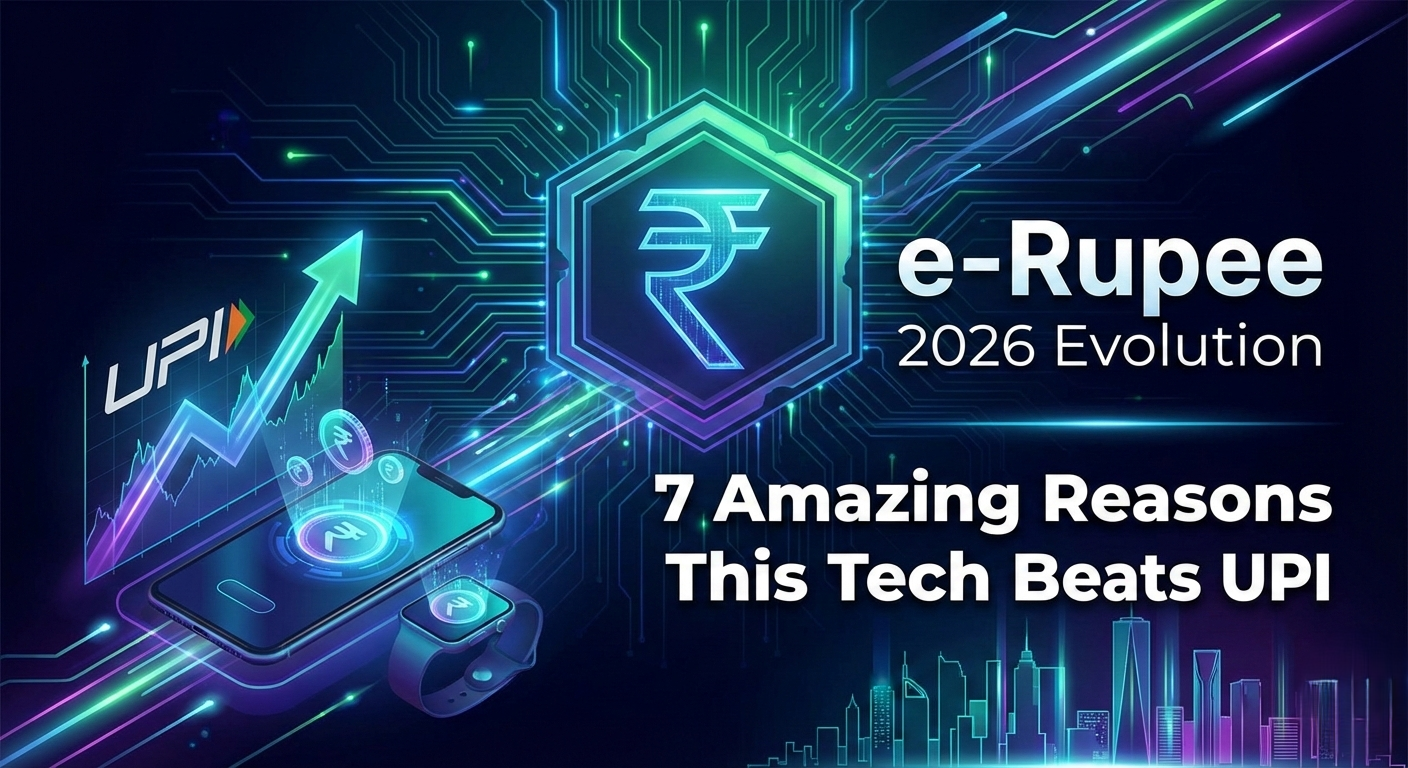
The Digital Rupee e-Rupee 2026 Evolution has officially arrived, transforming the way 1.4 billion Indians interact with money. While UPI made payments fast, the new Central Bank Digital Currency (CBDC) is making money “smart.” In 2026, we are no longer just sending digital instructions between banks; we are carrying actual sovereign digital cash that functions even without the internet.
1. Digital Rupee vs UPI for Smart Savings
The most common question in 2026 is: why switch from UPI? The answer lies in the fundamental difference between a payment bridge and a digital asset. When you use UPI, you are moving money from a commercial bank account. With the Digital Rupee e-Rupee 2026 Evolution, you hold tokens issued directly by the Reserve Bank of India (RBI).
For those looking into Digital Rupee vs UPI for smart savings, the e-Rupee offers a “risk-free” digital wallet. Unlike a bank account that could face liquidity issues, the e-Rupee is legal tender in your phone. It’s a great way to separate your daily spending from your long-term wealth, much like how you’d plan how to start stock market trading in India 2026.
What is the fundamental difference between Digital Rupee and UPI?
While both are digital, the Digital Rupee e-Rupee 2026 Evolution is a digital version of cash issued by the RBI (a direct claim on the central bank). UPI, conversely, is a payment protocol that moves money between commercial bank accounts. With e-Rupee, you don’t need a bank to settle the transaction; the token itself is the value.
2. 5 Life-Changing Programmable Money Benefits for Indian Households
The true “magic” of 2026 is programmability. The RBI has enabled features that allow money to be “purpose-bound.” This means a parent can send e-Rupee to a child that can only be spent at a university canteen or a bookstore like the ones mentioned in our guide on books like Fourth Wing.
The Programmable money benefits for Indian households are vast:
- Subsidy Accuracy: Government benefits like the Biopharma Shakti Mission now reach recipients as tokens that cannot be diverted.
- Expense Control: Set “Grocery-only” tokens to manage your budget for the best rice cooker in India 2026.
- Automatic Payments: Program your rent to release only when a digital contract condition is met.
3. e-Rupee Offline Transactions India: Payments Without Internet
Internet “dead zones” are a thing of the past for digital payments. The e-Rupee offline transactions India feature uses Near Field Communication (NFC) to allow device-to-device transfers. This is a game-changer for rural India and hilly regions where UPI often fails.
Whether you are in a remote basement checking your best wifi security camera or hiking in the wild with your solar-powered gadgets, you can now “tap and pay” with 100% certainty.
4. RBI CBDC Wallet Security 2026: Moving Beyond OTPs
Google and the RBI have both prioritized security this year. The RBI CBDC wallet security 2026 framework has phased out unreliable SMS OTPs in favor of “Dynamic 2FA.” This uses hardware-bound tokens and biometric scans—similar to the security on a high-end Asus ROG 2026 laptop.
As we navigate the new India IT Rules 2026 and Deepfake Laws, having a payment system that is cryptographically secured by the central bank provides a layer of trust that private wallets cannot match.
5. Integration with the Modern “MithVibe” Lifestyle
Efficiency is the core of MithVibe. Just as we look for the best robot vacuum cleaner in India or the best Dyson cordless vacuum to save time, the Digital Rupee e-Rupee 2026 Evolution saves mental energy by automating our finances.
For creators in a solo content creator studio, the e-Rupee allows for instant, micro-payments for Instagram Reels gear without the high transaction fees associated with traditional credit cards.
6. Better Tax and Rebate Management
Using the Digital Rupee makes filing taxes easier. Because every token has a clear “pedigree” on the RBI ledger, calculating your Section 87A rebate for 2026 becomes a matter of clicking a button rather than hunting through bank statements.
7. Health and Environment: A Greener Rupee
Printing and transporting physical cash is expensive and environmentally taxing. By adopting the Digital Rupee e-Rupee 2026 Evolution, India is reducing its carbon footprint. It’s a clean-tech move, much like switching to the best air purifiers for allergies or using Korean sunscreen for oily skin to avoid harsh chemicals.
MithVibe Tech Reviews: Powering Your 2026
As you upgrade your wallet, don’t forget to upgrade your gear. We’ve tested the latest tech to ensure your 2026 is seamless:
- Mobile: Stop the Galaxy Z Fold 7 battery drain with our optimization guide.
- Fitness: Build your home gym with the best treadmills in the USA.
- Editing: Use Retouch4me in 2026 for AI-powered photo finishing.
- Warning: Stay safe from the Roborock Saros stair-climbing scam.
The 2026 Payment Choice: Digital Rupee vs UPI vs Cash
To help you decide which tool to use for your daily transactions, here is a quick breakdown of how these three pillars of the Indian economy compare in 2026.
| Feature | Digital Rupee (e₹) | UPI (Digital Rail) | Physical Cash |
| Nature | Sovereign Digital Currency | Payment Interface | Sovereign Physical Currency |
| Issuer | Reserve Bank of India (RBI) | NPCI / Commercial Banks | Reserve Bank of India (RBI) |
| Settlement | Immediate (Finality) | Interbank (Deferred) | Immediate (Hand-to-Hand) |
| Internet Need | Optional (Offline Mode) | Mandatory (Online) | None |
| Programmability | Yes (e.g., University Fees only) | No | No |
| Privacy Level | High (Managed Anonymity) | Low (Bank-Linked) | Maximum (Anonymous) |
| Transaction Fee | Zero | Mostly Zero | Zero |
Conclusion: Embracing the Future of Indian Finance
The Digital Rupee e-Rupee 2026 Evolution is not just a technological upgrade; it is a shift toward a more resilient, inclusive, and efficient India. While UPI has become the lifeblood of our daily commerce, the e-Rupee provides a sovereign backup that works without the internet, keeps our data more private, and allows us to “program” our financial goals.
As we move deeper into 2026, the lines between our gadgets and our wallets continue to blur. Whether you are optimizing your life with the best robot vacuum cleaner in India or securing your digital assets with the latest RBI CBDC wallet security protocols, the goal remains the same: total control over your environment and your future.
By understanding these tools today—from the Section 87A tax rebate to the nuances of programmable money—you aren’t just reacting to the economy; you are leading it. Stay tuned to MithVibe for the latest updates on the tech that moves your world.
Can I use the Digital Rupee offline without an internet connection?
Yes. In 2026, the RBI has rolled out “proximity-based” offline payments. Using NFC (Near Field Communication) technology, you can “tap and pay” between two devices. The transaction is stored on a secure hardware chip in your phone and syncs with the ledger once you are back online.
What are the specific “Programmable Money” benefits for Indian families?
Programmability allows you to set “rules” for your money. For example, parents can send e-Rupee to their children that is programmed to only be valid at school bookstores or specific grocery outlets. This ensures that subsidies or allowances are spent exactly where intended.
Does the Digital Rupee track my personal privacy more than cash?
The RBI CBDC wallet security 2026 framework is designed with “Managed Anonymity.” Small, coffee-shop-sized transactions enjoy a level of privacy similar to physical cash. However, high-value transfers are recorded on the RBI ledger to prevent money laundering and fraud, striking a balance between privacy and national security.
Why does the Digital Rupee wallet not offer interest like a savings account?
Because the Digital Rupee is “digital cash,” it mirrors physical currency, which does not earn interest in your physical wallet. To earn interest, you must “deposit” your e-Rupee back into a traditional bank account, converting it into a commercial bank liability.
What happens to my e-Rupee if I lose my smartphone?
Your money is not stored as a simple file on your phone; it is linked to your digital identity. Through the RBI CBDC wallet recovery process, you can restore your balance on a new device using your Aadhaar-linked biometrics and 2FA, ensuring your “digital cash” isn’t lost like a dropped physical wallet.
Are there transaction limits for e-Rupee in 2026?
Current 2026 regulations typically limit retail wallets to ₹1,00,000 for security. Standard daily transaction limits are capped at ₹50,000 or 20 transactions per day, though these are higher for verified merchant accounts to facilitate business growth.
Is the Digital Rupee the same as Bitcoin or other Cryptocurrencies?
No. Bitcoin is a decentralized, volatile “private” asset with no backing. The Digital Rupee e-Rupee 2026 Evolution is a Central Bank Digital Currency (CBDC). It is legal tender, has a stable value pegged 1:1 with the physical rupee, and is fully regulated by the Indian government.
Can I pay with e-Rupee at a shop that only has a UPI QR code?
Yes. As of 2026, the RBI has ensured full interoperability. You can scan any standard UPI QR code using your Digital Rupee app. The system automatically handles the back-end conversion to ensure the merchant receives the payment seamlessly.
How does the e-Rupee help with Section 87A Tax Rebates?
By using the Digital Rupee for business expenses, your transaction history is neatly categorized on the RBI’s secure ledger. When filing your ITR, this data can be auto-imported, making it easier to claim your Section 87A rebate for 2026 (valid for income up to ₹12 Lakh under the New Regime).
Does using the Digital Rupee require a bank account?
Currently, most wallets are linked to a bank account for easy “loading” and “unloading” of funds. However, the 2026 “Financial Inclusion” phase allows unbanked individuals to open “Tier-1” wallets using only Aadhaar verification at designated post offices or kiosks.
Is the Digital Rupee better for the environment?
Absolutely. The environmental cost of mining, printing, storing, and transporting physical currency is massive. The e-Rupee reduces the carbon footprint of the Indian economy by moving toward a “mint-on-demand” digital ledger system.
Can international travelers use the Indian Digital Rupee?
Yes. Under Project Nexus, India has linked its CBDC with several other nations. Tourists can now exchange their home currency for e-Rupee tokens to use locally in India without paying high currency conversion fees at airports.
Can I use e-Rupee on my smartwatch or wearable tech?
The 2026 evolution includes “Tokenized Wearables.” You can link a small portion of your e-Rupee wallet to your smartwatch or smart ring for “tap-to-pay” convenience, even if your phone is at home.
Are there any fees for merchants to accept Digital Rupee?
One of the biggest advantages for shopkeepers is the Zero MDR (Merchant Discount Rate). Unlike credit cards that charge 2-3%, accepting the Digital Rupee is completely free for merchants, making it the preferred choice for small businesses.