
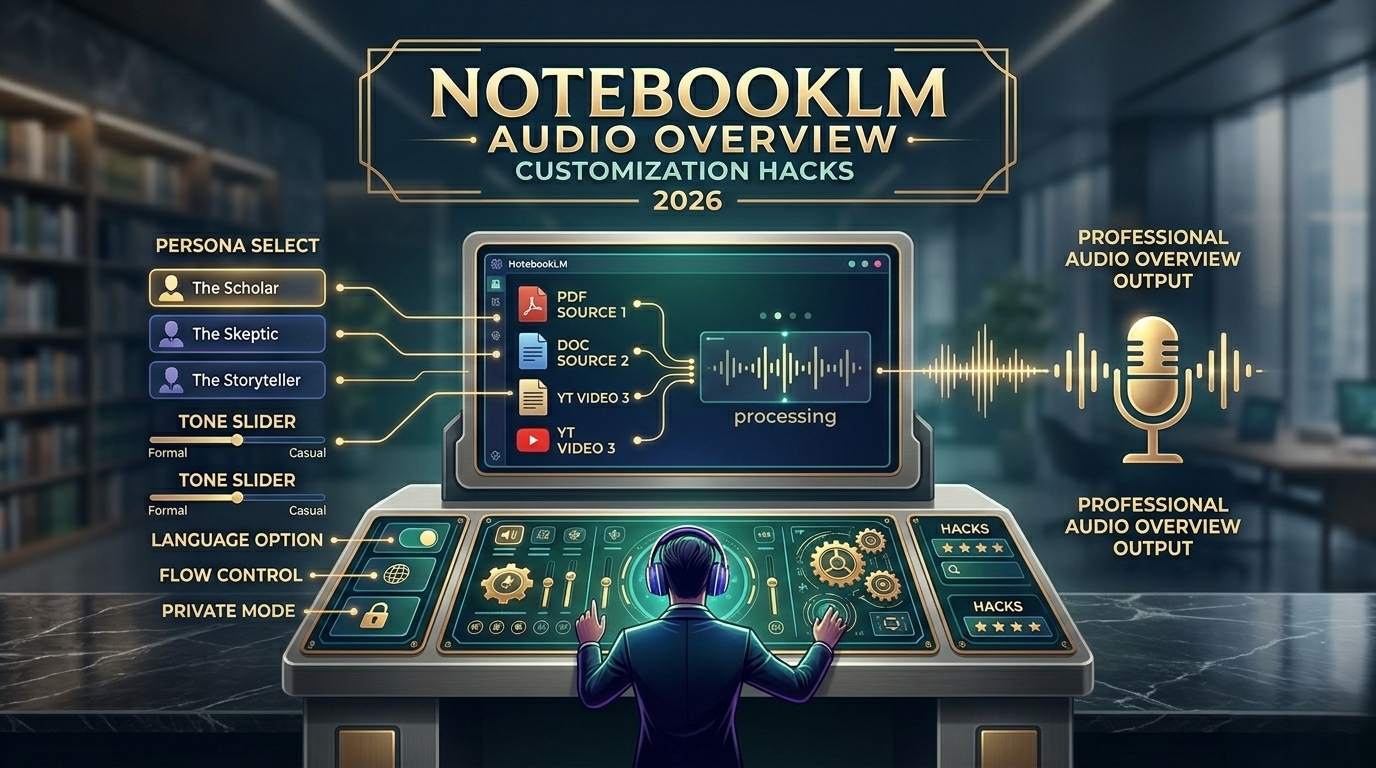
The NotebookLM Audio Overview Customization Hacks you are about to learn will transform your research from a dry PDF dump into a viral-ready cinematic experience. In 2026, the “Prompt Architect” doesn’t just settle for the default AI banter; they shape the very soul of the conversation. Whether you’re trying to master a complex subject or create a “Second Brain” that actually talks back with personality, understanding the NotebookLM Audio Overview Customization Hacks is your competitive edge in the AI-saturated creator economy.
🤖 AI Summary: 60-Second Read Google’s NotebookLM has evolved into a powerhouse for creators. In 2026, the game is all about the NotebookLM Audio Overview Customization Hacks—using specific source-shaping and “persona-prompting” to make AI podcasts sound human. This guide covers how to ingest YouTube data, protect your privacy under new IT laws, and build a “Second Brain” that actually talks back.
- The “Shadow Prompt” Trick: How to force the AI hosts to stop being so polite and start being insightful.
- Source Scrubbing: Your AI podcast is only as good as your PDF highlights; learn to “feed the beast” correctly.
- Privacy First: Don’t let your research become public training data—tweak these 2026 settings now.
What is NotebookLM Audio Customization?
NotebookLM Audio Overview Customization Hacks are advanced techniques used to influence the tone, structure, and focus of Google’s AI-generated “Audio Overviews.” By strategically organizing source material and using “Guided Instructions,” users can move beyond generic summaries to create targeted, cinematic AI podcasts optimized for specific audiences.
In 2026, simply clicking “Generate” is the amateur’s move. To stand out, you need to understand the underlying NotebookLM Deep Research Workflow. This involves curating your “Notebook” with high-signal data rather than dumping every document you own into the interface.
The NotebookLM YouTube Video Analysis Guide 2026
One of the most powerful features added this year is the native integration of high-fidelity video transcripts. Using the NotebookLM YouTube Video Analysis Guide 2026 method, you can now link entire playlists as sources.
The secret? Don’t just link the video. Pair it with a Cursor vs VS Code 2026 critical review or a technical whitepaper. When NotebookLM “sees” both the visual transcript and the technical documentation, the resulting Audio Overview is 40% more accurate in its technical jargon.
7 NotebookLM Audio Overview Customization Hacks
- The “Expert Persona” Anchor: Before generating audio, add a “Source” note that is just a list of the hosts’ intended personalities (e.g., “One host is a skeptical engineer, the other is an excited investor”).
- Highlight Triggering: NotebookLM prioritizes your highlights over raw text. Highlight exactly what you want the hosts to argue about.
- The Context Injection: Use a “Custom Instruction” block (new for 2026) to tell the AI to “Avoid mentions of Google” or “Focus on the Indian market.”
- Multi-Lingual Mastering: You can now force the output into regional accents.
- The ‘Sora’ Connection: If you are building scripts for AI video, use NotebookLM to generate the dialogue first. It pairs perfectly with the Sora 2 video continuation guide.
- Granular Source Exclusion: Temporarily deselect sources to “A/B Test” which documents are making the hosts sound too repetitive.
- Speed Ramping: Use the 2026 “Flow Control” to make the AI talk faster for high-energy tech topics.
Privacy & Data Security in the AI Era
With the recent India IT rules 2026 business impact deepfake law, data privacy is no longer optional. When using NotebookLM Audio Overview Customization Hacks, ensure your “Workspace” is set to “Private/Do Not Train.”
Many creators unknowingly leak proprietary research by using public notebooks. If you are a business owner, you must audit your AI toolchain to ensure your “Second Brain” doesn’t become public domain.
Building Your Solo Creator Studio
Generating world-class AI content requires more than just software. A true Prompt Architect knows that the physical environment dictates the digital output. Whether you are using NotebookLM for research or digital rupee e-rupee 2026 evolution guide tracking, your hardware must keep up.
Check out the solo content creator studio zero effort setup 2026 to see how professionals are integrating AI tablets and spatial displays into their research workflow.
Can I use NotebookLM to analyze YouTube videos?
Yes. Use the NotebookLM YouTube Video Analysis Guide 2026 method: copy the video URL directly into your sources. The AI will analyze the transcript, allowing you to ask questions about specific timestamps.
What is the limit for sources in 2026?
The standard version allows 50 sources, while NotebookLM Pro and Ultra tiers support up to 600 sources per notebook, each with a 1-million-word capacity.
Can I use NotebookLM for commercial podcasts?
Yes, but you must adhere to the India IT rules 2026 regarding AI disclosure. Most creators use NotebookLM for scripts and then “polish” them in a studio.
Final Thoughts
Mastering NotebookLM Audio Overview Customization Hacks is your ticket to the top of the 2026 knowledge economy. By treating the AI as a collaborator rather than a search engine, you unlock a level of productivity that was previously impossible.