
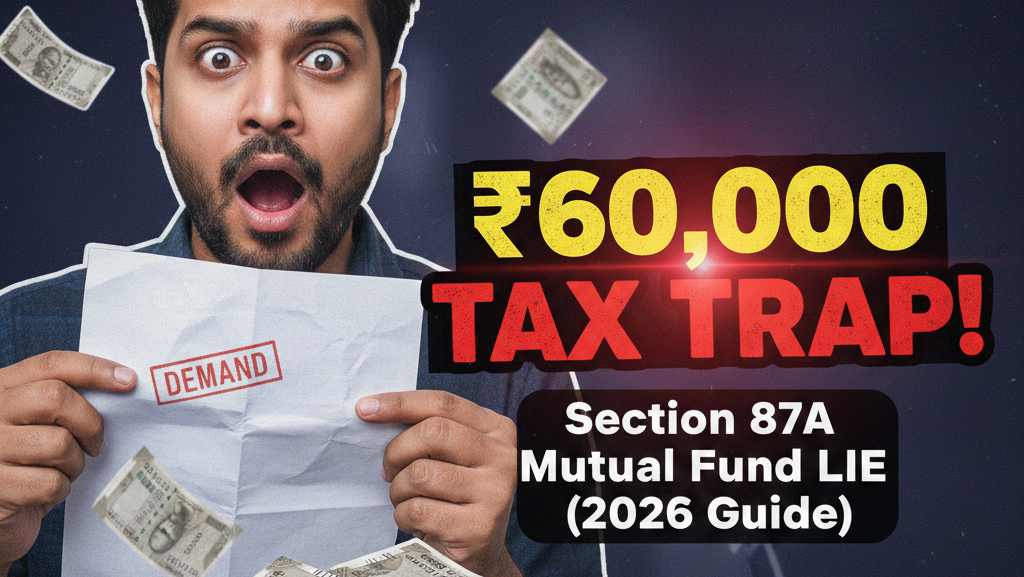
If you run a shop, a small agency, or are a freelance professional in India, the “Zero Tax up to ₹12 Lakhs” headline felt like a massive win. But as you prepare your filings, you might notice something strange: your tax isn’t zero. This is the Section 87A rebate on special rate income 2026 trap.
Is the Section 87A rebate available for income up to ₹12 Lakhs in 2026?
Yes, under the New Tax Regime for FY 2025-26, resident individuals with a total income up to ₹12,00,000 are eligible for a rebate of up to ₹60,000. However, this only applies to “normal” income taxed at slab rates.
The law currently treats your business income (slab rate) and your investment income (special rate) differently. If you have profits from stocks or mutual funds, they can “block” your rebate, leaving you with a bill of ₹40,000 to ₹60,000.
Navigating the 2026 tax landscape requires understanding more than just local laws; it requires a global perspective. As we’ve seen with the recent Trump-India trade deal impact on stocks, sudden market shifts can trigger the very capital gains that lead you into this tax trap. Staying ahead of these macro trends is the first step in proactive tax planning.
Why is my tax not zero even though my income is below ₹12 Lakhs?
This is usually due to the Section 87A rebate on special rate income 2026 restriction. If your income includes “Special Rate” earnings like Short-Term Capital Gains (STCG) or Long-Term Capital Gains (LTCG) from stocks/mutual funds, the rebate cannot be used to offset the tax on those specific gains.
A common reason for this discrepancy is the failure to realize how different income streams interact. For a deep dive into how these rules specifically target investors, check our detailed breakdown of the Section 87A mutual fund trap budget 2026. Understanding the ‘Normal’ vs ‘Special’ income rooms is vital to keeping your tax bill at zero.
The “Special Rate” Conflict Table
| Income Source | 2026 Tax Rate | Rebate Eligibility |
| Business/Professional Profits | Standard Slabs | ✅ Full Rebate |
| Equity Stocks (Short Term) | 20% | ❌ STCG 111A rebate eligibility new regime is limited |
| Equity Mutual Funds (Long Term) | 12.5% | ❌ Above Section 112A capital gains tax-free limit 2026 |
| Debt Mutual Funds | Slabs | ✅ Allowed via ITAT Chandigarh ruling Section 87A debt mutual fund |
25-Step Click-by-Click Small Business Manual
Phase 1: The “Stock-Check” Audit (Steps 1-7)
- Step 1: Open your brokerage app (Zerodha, Groww, etc.).
- Step 2: Click Profile > Reports > Tax P&L.
- Step 3: Set the date range for April 1, 2025, to March 31, 2026.
- Step 4: Download the Excel file.
- Step 5: Filter for Section 111A. This is your Short-Term Capital Gain.
- Step 6: Check your STCG 111A rebate eligibility new regime total. If this is positive, you will likely owe 20% tax regardless of your total income.
- Step 7: Filter for Section 112A and check if you have stayed under the Section 112A capital gains tax-free limit 2026 of ₹1.25 Lakhs.
When auditing your gains, accuracy is everything. Relying on real-time market data 2026 analysis ensures you aren’t making sell-decisions based on lagging figures, which could accidentally push you over the tax-free threshold. If you are a high-volume trader or a business owner managing your own portfolio, clean data is your best defense against the 87A blocker.
Phase 2: Government Portal Verification (Steps 8-15)
- Step 8: Go to the Income Tax e-Filing Portal.
- Step 9: Log in with your PAN.
- Step 10: Click Services > Annual Information Statement (AIS).
- Step 11: Download the Simplified TIS (Taxpayer Information Summary).
- Step 12: Cross-check your “Business Turnover” with your bank statements.
- Step 13: Locate the “Sale of Securities” section.
- Step 14: Ensure the 111A and 112A figures match your brokerage Excel exactly.
- Step 15: If the portal says you earn more than you did, click “Feedback” to correct it now.
For small business owners, tax efficiency is just one part of the puzzle; operational efficiency is the other. Many creators are now using AI-driven tools like the Retouch4me 2026 plugins to save hours on manual work—hours that are better spent double-checking your AIS and TIS records to ensure the government hasn’t miscalculated your ‘Special Rate’ income.
Phase 3: Identify Your “Trap” (Steps 16-20)
- Step 16: Open the official Income Tax Calculator.
- Step 17: Input your business profits.
- Step 18: Add your mutual fund gains.
- Step 19: If the “Tax Payable” is not zero, the Section 87A rebate on special rate income 2026 is being blocked by your stock profits.
- Step 20: If your income is just over ₹12 Lakhs, you must perform a Marginal relief calculation for 12 lakh income.
Phase 4: Taking Corrective Action (Steps 21-25)
- Step 21: Use the Marginal relief calculation for 12 lakh income formula: $Tax = Income – 12,00,000$.
- Step 22: If you have debt funds, cite the ITAT Chandigarh ruling Section 87A debt mutual fund to your auditor.
- Step 23: This ITAT Chandigarh ruling Section 87A debt mutual fund ensures you don’t pay 20% on debt gains unnecessarily.
- Step 24: Stay under the Section 112A capital gains tax-free limit 2026 by delaying further sales until April.
- Step 25: Ensure your STCG 111A rebate eligibility new regime doesn’t push you into a 20% tax bracket by “loss harvesting” (selling bad stocks to offset gains).
While you focus on saving your ₹60,000 rebate, don’t forget to automate your physical workspace as well. Just as we automate our tax-harvesting, using the best robot vacuum cleaner in India 2026 can keep your office clean while you dive deep into spreadsheets. For those working long hours during tax season, switching to safe air fryers for 2026 is a quick way to stay healthy without losing time on meal prep.
The Visual: The 87A Rebate “Wall”
| If your Income is… | And you have… | The Resulting Tax Situation |
| Below ₹12 Lakhs | Only Salary/Business | ₹0 Tax (Full Rebate applied) |
| Below ₹12 Lakhs | Mutual Fund Gains | TAX PAYABLE (87A is blocked for MF) |
| Above ₹12 Lakhs | Any Income | FULL TAX (Rebate is lost completely) |
| ₹12,05,000 | Only Salary | ₹5,000 Tax (Using Marginal Relief) |
Visualizing the 2026 Tax Flow
Final Summary for Business Owners
The Section 87A rebate on special rate income 2026 is not a “one size fits all” rule. For small business owners, the key is balance. If your stock profits are high, your STCG 111A rebate eligibility new regime becomes the “leaky hole” in your bucket.
Always keep an eye on the Section 112A capital gains tax-free limit 2026 to keep your long-term profits safe. If you ever cross the 12L line, the Marginal relief calculation for 12 lakh income is your only protection against a massive tax jump. Lastly, for those holding safer assets, the ITAT Chandigarh ruling Section 87A debt mutual fund remains the definitive legal answer to protecting your rebate.
Does Section 87A rebate apply to Short-Term Capital Gains (STCG) u/s 111A?
No. Per the latest budget guidelines, STCG 111A rebate eligibility new regime rules state that the 87A rebate cannot be adjusted against tax arising from short-term capital gains on listed equity shares or equity-oriented mutual funds.
Can I claim the 87A rebate on Long-Term Capital Gains (LTCG) u/s 112A?
No. The Section 112A capital gains tax-free limit 2026 allows for an initial exemption of ₹1.25 Lakhs, but any tax calculated on gains above this limit is not eligible for the Section 87A rebate.
What did the ITAT Chandigarh rule about debt mutual funds and Section 87A?
The ITAT Chandigarh ruling Section 87A debt mutual fund (ITA No. 887/CHANDI/2025) clarified that while the rebate is blocked for equity (u/s 112A), it can be claimed against tax on capital gains from debt mutual funds, as they are not specifically excluded by the 112A(6) restriction.
How do I calculate Marginal Relief if my income is ₹12.1 Lakhs?
To perform a Marginal relief calculation for 12 lakh income, you ensure that your total tax does not exceed the amount by which your income exceeds ₹12 Lakhs. For an income of ₹12.1 Lakhs, your tax is capped at ₹10,000 (the “extra” ₹10k earned).
Is the ₹12 Lakh limit applicable to the Old Tax Regime too?
No. The ₹12 Lakh threshold is exclusive to the New Tax Regime. In the Old Tax Regime, the rebate remains capped at ₹12,500 for income up to ₹5 Lakhs.
Can NRIs claim the Section 87A rebate in 2026?
No, Section 87A is strictly available only to Resident Individuals. Non-Resident Indians (NRIs) are not eligible for this rebate regardless of their income level.
Do I need to file an ITR if my income is ₹8 Lakhs and my tax is zero?
Yes. Since the basic exemption limit is ₹4 Lakhs in 2026, you must file an ITR if your gross income exceeds this amount, even if the Section 87A rebate on special rate income 2026 brings your final tax to zero.
Is Section 87A applied automatically in the ITR portal?
Usually, yes. However, for those with STCG 111A rebate eligibility new regime issues, the portal often “denies” the rebate incorrectly. You must verify the calculation manually before submitting.
Does the ₹1.25 Lakh LTCG limit include STCG?
No. The Section 112A capital gains tax-free limit 2026 of ₹1.25 Lakhs applies only to Long-Term Capital Gains. Short-term gains are taxed from the first rupee at 20%.
Can Senior Citizens claim the ₹60,000 rebate?
Yes, resident senior citizens (aged 60-79) are eligible. However, “Super Senior” citizens (80+) typically follow different slab rules but are still generally eligible for 87A if they opt for the New Regime.
What happens if I have both Business Income and Mutual Fund Gains?
Your business income will get the rebate (tax becomes zero), but your Mutual Fund gains will be taxed at 12.5% or 20% without the benefit of the Section 87A rebate on special rate income 2026.
Can I use 80C deductions to stay under the ₹12 Lakh limit?
Only in the Old Tax Regime. If you are aiming for the ₹12 Lakh zero-tax limit in the New Regime, most 80C deductions are not allowed. You only get the Standard Deduction of ₹75,000.
What is the maximum tax I can save using Section 87A in 2026?
The maximum tax saving is ₹60,000 under the New Tax Regime, which effectively covers the tax on a “Normal” income of exactly ₹12,00,000.