
You’ve decided to launch a handmade organic skincare business. You have the aesthetic branding, the viral Instagram strategy, and the drive to succeed in India’s booming 2026 beauty market. But there is a silent killer lurking in your setup. If you are using cheap kitchen spatulas and baking scales, you are literally brewing a toxic disaster.
The barrier between a highly profitable brand and a devastating lawsuit is your equipment. Cross-contamination, inaccurate pH levels, and oxidized ingredients will bankrupt you before your first restock. Let’s do a deep analysis of the professional skincare formulation tools for home business you actually need to dominate the market, comparing the elite gear against the garbage you must avoid.
What equipment is needed to make skincare at home?
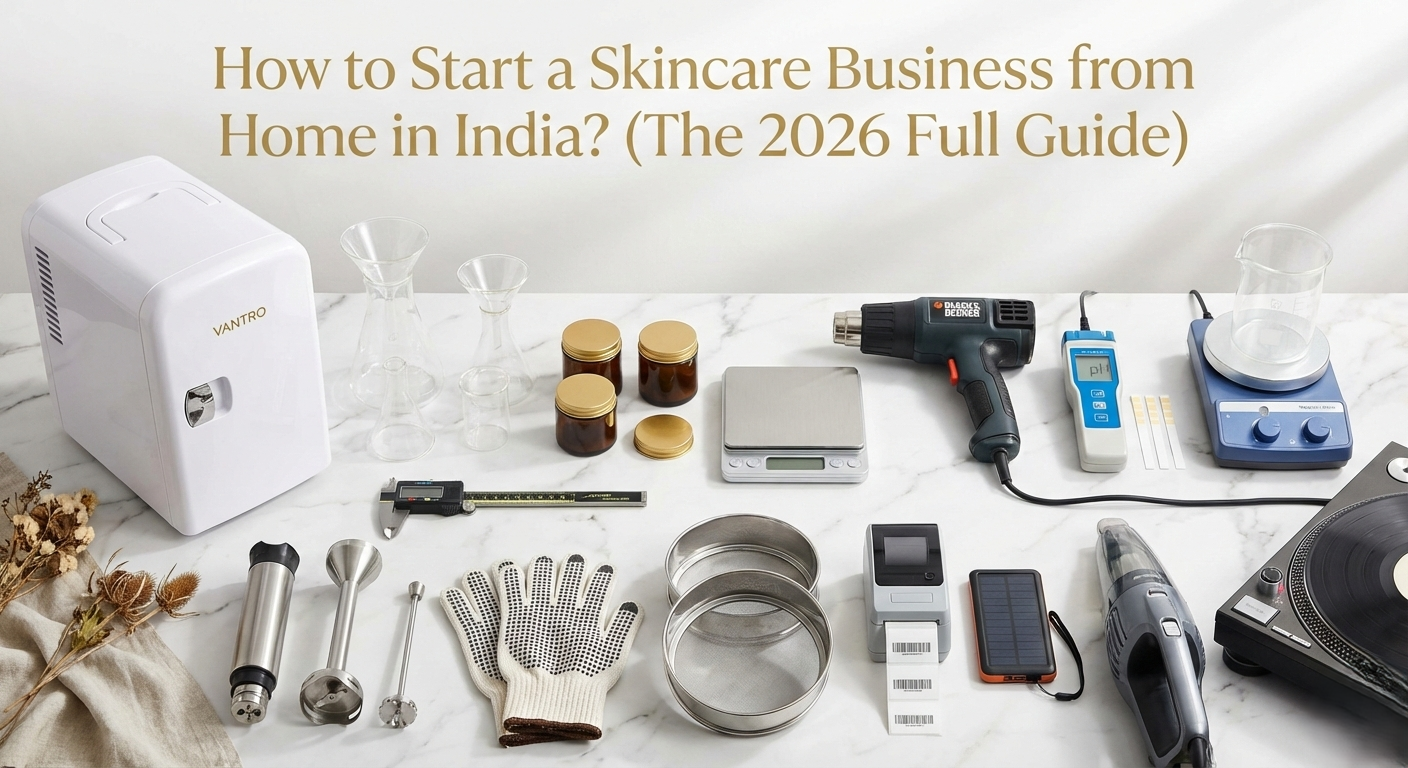
To safely manufacture cosmetics at home, you must upgrade to professional clean beauty lab equipment. Essential items include a 0.01g precision digital scale, borosilicate glass beakers, a high-torque stainless steel immersion blender, a digital pH meter, an infrared thermometer, and a dedicated cosmetic mini-fridge for storing active botanicals safely.
The Deep Analysis: Why Kitchen Tools Destroy Your Brand
When formulating serums or face packs, you are engaging in chemical science. The biggest pain point for new founders is product instability—lotions separating, serums growing mold, or face packs burning the skin.
1. The Measurement Catastrophe
Using a standard kitchen scale (which measures in 1g increments) for potent actives like Lactic Acid or preservatives is a fatal error. You need the best digital scale for cosmetic formulation that measures down to 0.01g. Being off by a fraction of a gram alters the pH entirely.
2. The Contamination Trap
Wood and cheap plastic absorb bacteria. If you stir a water-based serum with a wooden spoon, you introduce microbial life that will rot the product within weeks. Furthermore, airborne dust ruins curing soaps. Elite founders use the best air purifiers for allergies 2026 in their lab spaces to keep the air surgically clean during production.
3. The Temperature Disaster
Ayurvedic actives and cold-pressed oils degrade rapidly in Indian heat. Keeping them in a kitchen cupboard oxidizes them. You need dedicated cooling, such as the best mini fridge USA 2026 reviews (widely adopted globally), to maintain the integrity of your raw materials.
The “Zero-Effort” Content Creator Hack
If you are documenting your formulation journey for Instagram or YouTube (which you should!), don’t let the setup slow you down. Check out our guide on the solo content creator studio zero effort setup 2026 to film your process while keeping your hands free for formulating.
The 25 Essential Products: Your Professional Inventory List
To scale safely, we have categorized the 25 must-have ayurvedic product making tools and lab gear into four distinct phases of production.
Phase 1: Precision & Chemistry
- Digital Precision Scale (0.01g): The heartbeat of your lab.
- Digital pH Meter: Test strips are inaccurate; use a digital meter to ensure products stay between pH 4.5 and 5.5.
- Infrared Laser Thermometer: Instantly check the temperature of oils without touching them.
- Borosilicate Glass Beakers: Heat-resistant and non-porous.
- Magnetic Stirrer: For creating perfectly emulsified, high-end face serums.
- Stainless Steel Funnels: For sterile bottling.
Phase 2: Mixing & Heating
- Stainless Steel Double Boiler: Safely melt waxes and butters without burning them.
- High-Torque Immersion Blender: Essential for forcing oil and water to mix (emulsification).
- Seamless Silicone Spatulas: Bacteria cannot hide in seamless designs.
- Fine Mesh Sieves: For sifting ayurvedic powders to a micro-fine texture.
- Heat Gun: Used for popping air bubbles in poured balms and shrinking tamper-evident seals.
- Heat-resistant Nitrile Gloves & Goggles: Safety first. Protect your eyes from raw lye and concentrated acids. To learn more about lab safety compliance, check the FDA Guidelines for Cosmetic Good Manufacturing Practices.
Phase 3: Lab Maintenance & Storage
- Dedicated Cosmetic Mini-Fridge: Extends the life of botanical extracts.
- UV Amber Glass Jars: Protects finished products from UV light degradation.
- Air Purifier: Keeps the formulation room free of dust and spores.
- High-Efficiency Vacuum: Powder spills (like clay or mica) are a nightmare. A tool like the best Dyson cordless vacuum 2026 reviews ensures your lab stays spotless.
- WiFi Lab Monitor: Keep an eye on your slow-heating processes from your phone using the best WiFi security camera for home in India 2026.
- Solar Power Banks: Keep your scales and small electronics running off-grid with solar powered gadgets USA 2026 to cut electricity overhead.
Phase 4: Aesthetic Packaging & Content
- Bluetooth Thermal Label Printer: Print waterproof labels from your phone.
- Digital Caliper: Precisely measure bottles to order the exact right label sizes.
- Eco-friendly Compostable Mailers: 2026 consumers demand sustainable shipping.
- Solo Content Studio Kit: Use a solo content creator studio zero effort setup 2026 for BTS videos.
- Ring Light & Tripod: Essential Instagram reels creator gear 2026 for texture shots.
- Motorized Turntable: For 360-degree product videos.
- AI Retouching Software: Polish your final product photos effortlessly. Read the retouch4me review 2026 to see how AI speeds up your catalog creation.
Comparison Table: Toxic Hacks vs. Pro Solutions
| The Process | Toxic Amateur Mistake | The Professional Standard |
| Measuring | Plastic measuring cups | 0.01g Digital Scale |
| Sanitation | Washing tools in the kitchen sink | 70% Isopropyl Alcohol spray & wipe downs |
| Stirring | Wooden spoons (harbors bacteria) | Borosilicate Glass Rods / Seamless Silicone |
| Cooling | Kitchen fridge (cross-contamination with food) | Dedicated cosmetic chiller |
The Skincare Founder’s Manual
Can I legally manufacture skincare in a home kitchen in India in 2026?
No. Under the updated India IT Rules 2026 and CDSCO regulations, cosmetic manufacturing requires a Form 32 License. Your production area must be a dedicated, non-residential space that meets specific “Good Manufacturing Practices” (GMP). However, you can formulate “prototypes” at home using skincare formulation tools for home business before moving to a third-party manufacturer.
Why did my handmade face cream separate after just two weeks?
Instability is usually caused by poor emulsification or temperature fluctuations. If you didn’t use a high-shear immersion blender or if your “Cool Down Phase” temperatures were off by even $5^{\circ}C$, the oil and water bonds will break. Precision is non-negotiable.
Do I really need a digital pH meter, or are strips enough?
In 2026, “clean beauty lab equipment” is defined by science, not just ingredients. pH strips are notoriously inaccurate for colored or thick creams. A digital meter ensures your product stays in the “Skin-Safe Zone” ($pH\ 4.5\ to\ 5.5$). Anything outside this can cause “chemical burns” and brand-ending lawsuits.
What is the “Toxic Tool” mistake most new Indian founders make?
Using wooden spoons or porous plastic. These materials harbor microscopic mold spores that preservatives can’t always kill. Always use 304-grade stainless steel or borosilicate glass.
How do I stop my anhydrous (water-less) balms from feeling “gritty”?
Grittiness in shea or cocoa butter happens due to improper cooling (crystallization). You need a laser thermometer to track the “Flash Point” and must flash-cool your balms in a dedicated mini fridge to lock in a smooth texture.
Is it mandatory to use a preservative in “100% Natural” skincare?
If your product contains water, aloe juice, or hydrosols, you MUST use a preservative. Without it, your product becomes a breeding ground for Pseudomonas bacteria within 48 hours. Only 100% oil-based balms can skip preservatives (but still need Vitamin E to prevent rancidity).
How can I measure 0.05g of a potent active like Hyaluronic Acid?
A standard kitchen scale is your enemy. You require a Milligram Scale (0.01g or 0.001g accuracy). Inaccurate dosing of actives can lead to product failure or skin irritation.
What are the best air-cleaning protocols for a home lab?
Dust is the carrier of mold. Running a HEPA-filter air purifier for 30 minutes before you start formulating is a 2026 industry standard for small-batch creators.
Can I use tap water for my skincare formulations?
Never. Tap water contains minerals and chlorine that destabilize formulas and feed bacteria. Use only Distilled Water or Deionized Water to ensure a 12-month shelf life.
How do I prevent my botanical oils from going “rancid” in the Indian heat?
Heat and light are the “Oil Killers.” Store your expensive carrier oils in amber glass and keep them at a constant 18°C to 20°C.
What is “Cross-Contamination” in a home-based setup?
It’s using the same blender for your morning smoothie and your face wash. Even after “washing,” microscopic residues remain. Your clean beauty lab equipment must be 100% separate from household items.
Do I need an FSSAI license for my skincare brand?
Only if you are making “Edible Skincare” like sugar lip scrubs or beauty teas. Otherwise, you fall under the CDSCO (Central Drugs Standard Control Organization).
How do I get my product photos to look “Premium” on a budget?
Lighting is 90% of the work. Use a high-CRI LED ring light and clean up the “micro-dust” on your bottles using specialized retouching software.
What is the most expensive mistake in a new lab setup?
Buying “Hobbyist Kits.” They are overpriced and contain low-grade plastic tools. Buying individual, professional-grade skincare formulation tools for home business separately on Amazon India is 40% cheaper and lasts 5x longer.
How do I document my “Batch Records” for legal safety?
Every time you make a batch, you must record the Batch Number, Date, Temperature, and pH. This “Paper Trail” is your only defense if a customer claims your product caused a reaction.