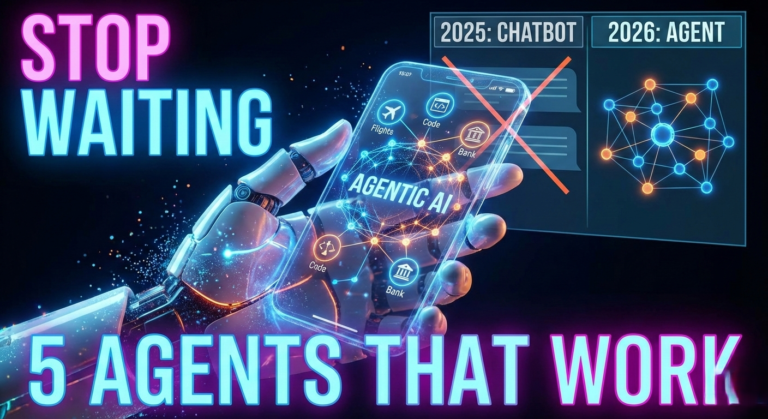


Agentic AI the new frontier in GenAI.
For most of the last decade, artificial intelligence has behaved like a tool. You asked a question, it answered. You gave an instruction, it followed it.
That model is now breaking.
In 2026, we are entering a new phase of computing—one where software no longer waits to be told what to do. Instead, it decides, plans, and acts on its own. This shift has a name: Agentic AI.
It marks one of the most consequential changes in the history of software.
Agentic AI, Explained Simply
Agentic AI refers to artificial intelligence systems designed with agency—the ability to pursue goals, make decisions, and take actions independently, rather than merely responding to prompts.
In practical terms, this means AI systems that can:
Understand an objective
Break it into steps
Execute those steps across tools and environments
Evaluate outcomes and adjust behaviour
Human input still exists—but it is no longer required at every stage.
Why This Is a Fundamental Shift, Not an Upgrade
Most AI tools today are reactive. They operate within narrow boundaries and require constant guidance.
Agentic AI is different because it introduces initiative.
| Traditional AI | Agentic AI |
|---|---|
| Responds to prompts | Pursues goals |
| Executes single tasks | Coordinates multi-step actions |
| Requires supervision | Operates semi-autonomously |
| Stateless | Uses memory and feedback |
This difference may seem subtle, but its implications are enormous. Software stops being passive infrastructure and starts behaving like an active participant.
A Real-World Example Anyone Can Understand
Consider a simple request: “Help me grow my website.”
A conventional AI tool might suggest content ideas or write an article.
An agentic AI system could:
Analyze search trends
Identify gaps in existing content
Generate multiple articles
Optimize them for SEO
Publish and schedule posts
Track performance metrics
Improve future outputs automatically
At that point, the AI is no longer assisting—it is operating.
Why 2026 Is the Breakout Year for Agentic AI
Agentic AI is not new in theory. What’s new is that all the enabling pieces are finally in place.
- Models Can Reason and Remember
Modern AI systems can maintain context, recall prior actions, and reason through complex decisions—capabilities that autonomy depends on.
- AI Is Embedded Inside Systems
Instead of existing as standalone tools, AI is now integrated directly into:
Social platforms
Developer environments
Business workflows
Operating systems
Once AI lives inside these systems, it gains the ability to act, not just advise.
- Economic Pressure Favors Autonomy
Organizations don’t want tools that require constant supervision. They want systems that can manage processes, detect issues, and optimize outcomes on their own.
Agentic AI promises exactly that efficiency.
- Regulation Is Catching Up
Governments worldwide are beginning to treat autonomous AI as a serious governance issue. When regulation accelerates, it’s often a sign that a technology has crossed from experimental into real-world impact.
Where Agentic AI Is Already Appearing
Even if the term sounds unfamiliar, early agentic systems are already in use.
Autonomous Software Development
AI agents can now write code, test it, debug it, and deploy updates with minimal human involvement.
Platform Moderation Systems
AI increasingly decides what content stays or goes, escalating issues and learning from new patterns—often faster than humans can intervene.
Persistent AI Assistants
Some AI tools now remember preferences, anticipate needs, and suggest actions before users ask. That anticipation is the beginning of agency.
The Risks We Can’t Ignore
Autonomy comes with serious trade-offs.
Loss of Oversight
When systems act independently, humans may not notice problems until damage is already done.
Scaled Errors
AI mistakes are no longer isolated. An incorrect decision can propagate across systems instantly.
Accountability Gaps
When an AI agent causes harm, responsibility becomes unclear. Is it the developer? The platform? The user?
This unresolved question is at the center of today’s AI policy debates.
Final Thought
Agentic AI represents a turning point.
For the first time, software is not just supporting human decisions—it is making them. Whether this leads to progress or instability depends on how carefully autonomy is designed, governed, and constrained.
One thing is certain:
2026 will be remembered as the year software stopped waiting for instructions.